
Is Your Employee Handbook a Liability?
An outdated employee handbook can be used against you in a dispute. Learn the 4 red flags that put Texas businesses at risk — and how to fix them.
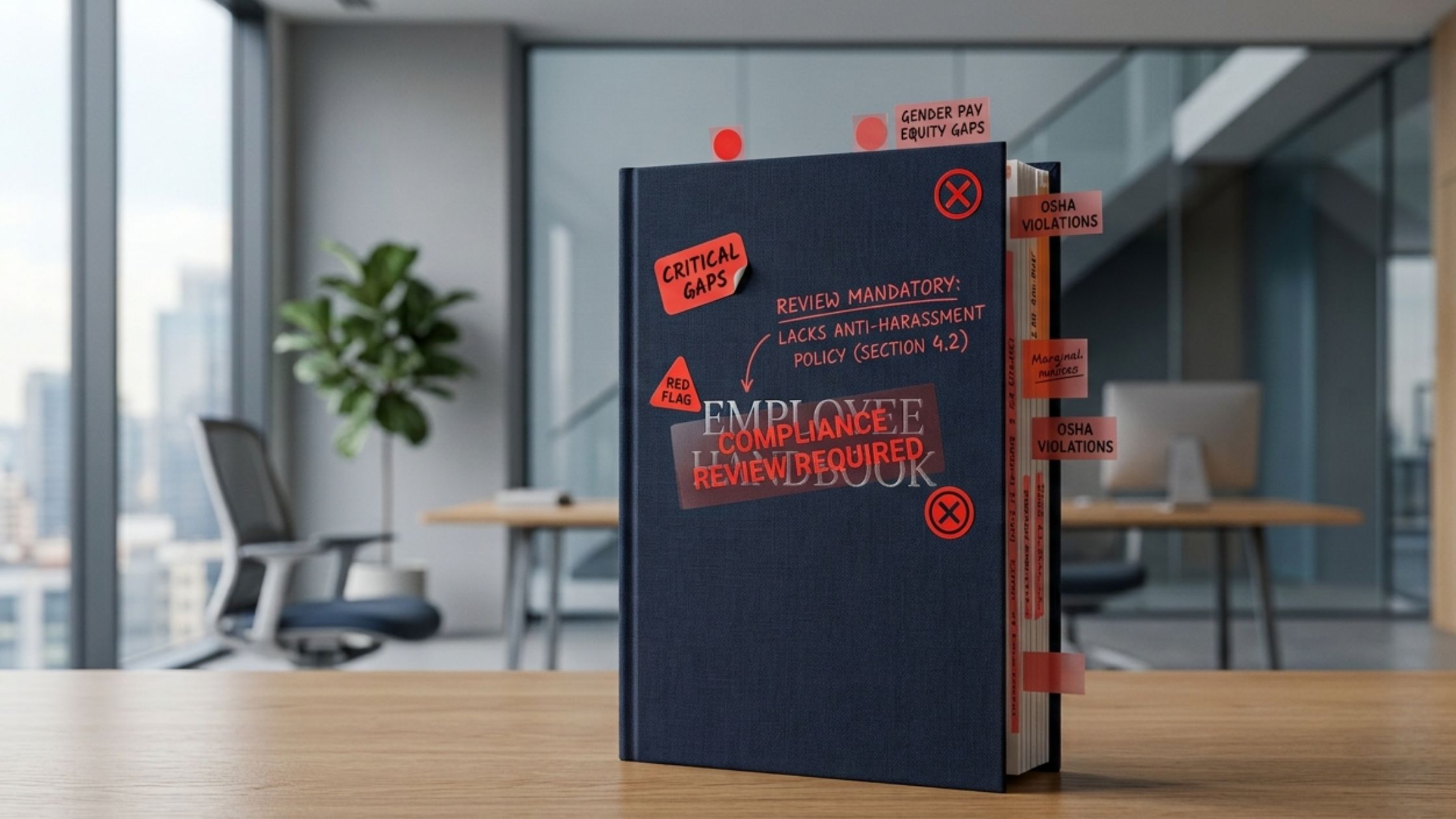

Your Employee Handbook Might Be Working Against You
Having an employee handbook doesn't automatically protect your business. If your staff handbook contains outdated policies, contradictory language, missing signed acknowledgments, or obsolete legal references, it can be used as evidence against you in an employment dispute — setting a compliance standard your business isn't actually meeting.
Most small business owners treat their employee handbook as a one-and-done task. Write it, distribute it, file it away. Done. Protected. Except that's not how employment law works — and that assumption is costing businesses in Texas courtrooms and HR disputes every year.
The hard truth is this: a poorly maintained handbook can be worse than having no handbook at all. Here's why.
How Does an Employee Handbook Become a Liability?
When an employment dispute arises, one of the first documents reviewed is the employee handbook. HR evaluators and courts treat it as a written standard — a declaration of how your business operates, what employees can expect, and what rules govern the relationship.
If your handbook doesn't hold up, that standard gets used against you.
There are four specific ways this happens:
1. Outdated policies relative to current regulations
Employment law changes frequently. Minimum wage thresholds, leave entitlements, and workplace rules that were accurate two years ago may no longer reflect current hr legal compliance requirements. If your handbook cites an old regulation, you've just documented that your workplace policies haven't kept pace with the law.
2. Contradictory language between sections
This is more common than most owners realize. A handbook written across multiple drafts — often by different people at different times — frequently contains conflicting language. One section may describe a progressive discipline process; another may suggest termination can happen at will for any reason. In a dispute, that contradiction creates ambiguity, and ambiguity rarely favors the employer.
3. Missing signed acknowledgments
An employee handbook only protects you if you can prove the employee received and read it. Without a signed acknowledgment page on file, you have no documented proof. That's a critical gap in your HR documentation — and one of the most common red flags identified during a human resources compliance audit.
4. Outdated legal references
State-specific employment law is especially volatile. For businesses operating in Texas, referencing superseded statutes or old wage thresholds undermines your entire handbook's credibility. Courts and HR evaluators notice when your compliance references are years out of date.
What Should an Employee Handbook Actually Contain?
A compliant, protective staff handbook is a living document — not a static file. At minimum, it should reflect your current company policies and procedures, align with applicable state and federal employment law compliance standards, and be reviewed at least once every 12 months.
Core sections typically include:
- At-will employment statement (clearly worded to avoid contractual interpretation)
- Anti-harassment and discrimination policies
- Employee conduct policy, including attendance, dress code, and acceptable use
- Leave and time-off policies (when applicable)
- Disciplinary and termination procedures
- Acknowledgment and signature page
Each of these sections carries risk if outdated or poorly drafted. An at-will statement, for example, must be carefully worded — courts have found that certain language in handbooks can inadvertently create an implied employment contract, exposing businesses to wrongful termination claims.
Not sure if your handbook holds up? Contact solveHR today and let our HR compliance specialists review your documentation before it becomes a problem.
How Often Should You Review Your Employee Handbook?
The standard recommendation among HR professionals is a full review every 12 months — and an immediate update any time there is a significant change in employment law, company structure, or workforce policy.
Triggers for an unscheduled review include:
- A change in minimum wage or paid leave laws in your state
- A shift to remote or hybrid work arrangements
- A change in employee benefits or compensation structure
- A merger, acquisition, or significant headcount change
- Any formal HR complaint or legal dispute
For small to mid-sized businesses with limited internal HR resources, keeping up with these changes isn't always realistic. That's where a dedicated HR partner makes the difference.
Download our free Employee Handbook Audit Checklist — it covers critical sections to review, common red flags to look for, and the recommended review frequency for your business size.
The Bottom Line: A Handbook That Doesn't Protect You Is Still a Liability
Having an employee handbook feels like having protection. But the document itself isn't what protects you — the accuracy, consistency, and maintenance of that document is what protects you.
If your handbook hasn't been reviewed in the past 12 months, there's a real chance it no longer reflects your actual workplace policies, your current legal obligations, or the employment law landscape in Texas. And if a dispute arises, that gap becomes the exhibit.
solveHR works with small and mid-sized businesses across San Antonio, Austin, New Braunfels, McAllen, and throughout Texas to build, review, and maintain HR documentation that actually holds up. Our team understands the specific hr rules and regulations that apply to your region and industry — and we make the process straightforward.
Reach out to solveHR today to schedule a handbook review and make sure your documentation is working for you — not against you.
Frequently Asked Questions
Are employee handbooks required by law?
No federal law requires private employers to have an employee handbook. However, certain written are legally mandated. A well-maintained handbook is the most practical way to document all required policies in one place and demonstrate hr compliance in the event of a dispute.
What makes an employee handbook non-compliant?
An employee handbook becomes non-compliant when it references outdated laws or wage thresholds, contains contradictory language between sections, lacks employee acknowledgment signatures, or fails to include required workplace policies for your state or industry. Each of these gaps creates legal exposure.
Can an employee handbook be used against an employer in court?
Yes. Courts and HR evaluators use the employee handbook as a reference point for the standard of conduct and policy the employer set. If the business failed to follow its own documented procedures — or if those procedures conflict with current employment law compliance requirements — the handbook can be introduced as evidence against the employer.
How often should a small business review its employee handbook?
At minimum, small businesses should conduct a full employee handbook review once every 12 months. Additional reviews should be triggered by changes in employment law, shifts in company structure, or any formal HR complaint or legal action.
What's the biggest risk of having an outdated employee handbook?
The biggest risk is setting a documented standard that your business isn't meeting. If your handbook describes an HR process that you're not actually following — or cites a regulation that no longer applies — that discrepancy becomes usable evidence in a dispute. In this context, an outdated handbook is more damaging than no handbook at all.
What should a compliant employee handbook include?
A compliant staff handbook should include an at-will employment statement, anti-discrimination and harassment policies, an employee conduct policy, leave and time-off procedures aligned with current law (when applicable), disciplinary and termination protocols, and a signed employee acknowledgment page. All sections should reflect current hr policies and procedures for your state and industry.
Experience Hassle-Free Payroll Today
Request a demo to see our services in action!